
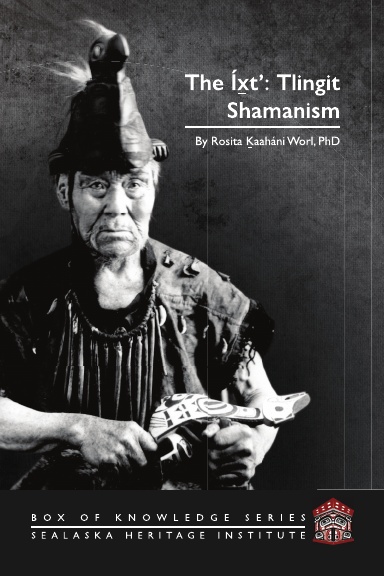
New book details Tlingit shamanism
“The Íx̱t’: Tlingit Shamanism” provides an overview of the practice and its history
July 21, 2026
Sealaska Heritage Institute (SHI) has published a book on Tlingit shamans, who possessed the power to communicate with supernatural entities and to heal clan members. The book’s release precedes a shamanism exhibit SHI will open next year.
The book, “The Íx̱t’: Tlingit Shamanism,” was written by Tlingit anthropologist and SHI President Rosita Worl, Ph.D. and delves into the practice, which was once a major part of Tlingit culture.
Before the arrival of Western settlers, the íx̱t’ served as a conduit between the natural and supernatural worlds. Russians and Americans who settled among the Tlingit in the 1800s viewed the practice as sacrilegious and began to persecute shamans, hunting and torturing them to suppress shamanism.
“In the minds of the Tlingit, it was ironic that witches who were viewed as practitioners of evil were protected by the American officials while shamans who were responsible for the general welfare of the Tlingit were persecuted,” Dr. Worl writes.
Shamans kept members of their clans safe in a myriad of ways. In addition to ensuring spiritual harmony, each clan’s íx̱t’ oversaw everyone’s physical safety by curing illnesses and providing strategic intelligence during battles. The íx̱t’ also predicted future events. Sometime between 1841 and 1866, a geographer’s account of a séance concluded with a shaman’s prophecy of the arrival of Western settlers and the diseases they’d bring with them.
Those illnesses and Western acts of repression ultimately led to the decline of shamanism. However, shamanism isn’t entirely extinct because elements of the practice are still evident. The beliefs that all beings in the natural realm have spirits and interrelationships between humans and the spirit world continue to serve as the core themes of shamanism.
“These beliefs persist among traditional Tlingit today,” Dr. Worl writes.
The book was published through SHI’s Box of Knowledge series, which consists of books and essays about Tlingit, Haida and Tsimshian culture. The series is available through the Sealaska Heritage Store.
SHI will open the shamanism exhibit in April 2027, with University of Alaska Southeast Professor of Alaska Native Languages X̱’unei Lance Twitchell of the Tlingit Lukaax̱.ádi clan serving as the curator. Because of the spiritual beliefs and practices associated with shamanism, the SHI’s Council of Traditional Scholars (CTS) initially restricted exhibitions of shamanism; however, after reconsideration of SHI’s mission to promote cross cultural understanding, the CTS adopted a resolution to guide the development of Tlingit, Haida, and Tsimshian shaman exhibits. They believed the protocols they adopted would protect the traditional culture of the Tlingit, Haida, and Tsimshians as well as the Indigenous Peoples themselves. Because of the sacredness and the rules governing shamanic objects, it was their hope that museums would return shamanic objects to its clan owners. SHI’s exhibit will adhere to the resolution adopted by the CTS.
Sealaska Heritage Institute is a tribal organization founded in 1980 to perpetuate and enhance Tlingit, Haida and Tsimshian cultures of Southeast Alaska. SHI also conducts scientific and public policy research that promotes Alaska Native arts, cultures, history and education statewide. The institute is governed by a Board of Trustees and guided by a Council of Traditional Scholars, a Native Artist Committee, a Southeast Regional Language Committee and an Education Committee.
Caption: Cover of “The Íx̱t’: Tlingit Shamanism.” Note: News outlets are welcome to use this photo for coverage of this story. For a higher-res version, contact kathy.dye@sealaskaheritage.com.