Sealaska Heritage to sponsor lecture series for Native American Heritage Month
Free event to be offered in-person, virtually
Sealaska Heritage Institute (SHI) will sponsor a lecture series throughout November in honor of Native American History Month.
Community members are invited to attend the lectures in person at Shuká Hít (the clan house) in the Walter Soboleff Building in downtown Juneau or virtually by tuning in to SHI’s YouTube channel, where the talks will be live streamed. Viewers are encouraged to ask questions in-person and online.
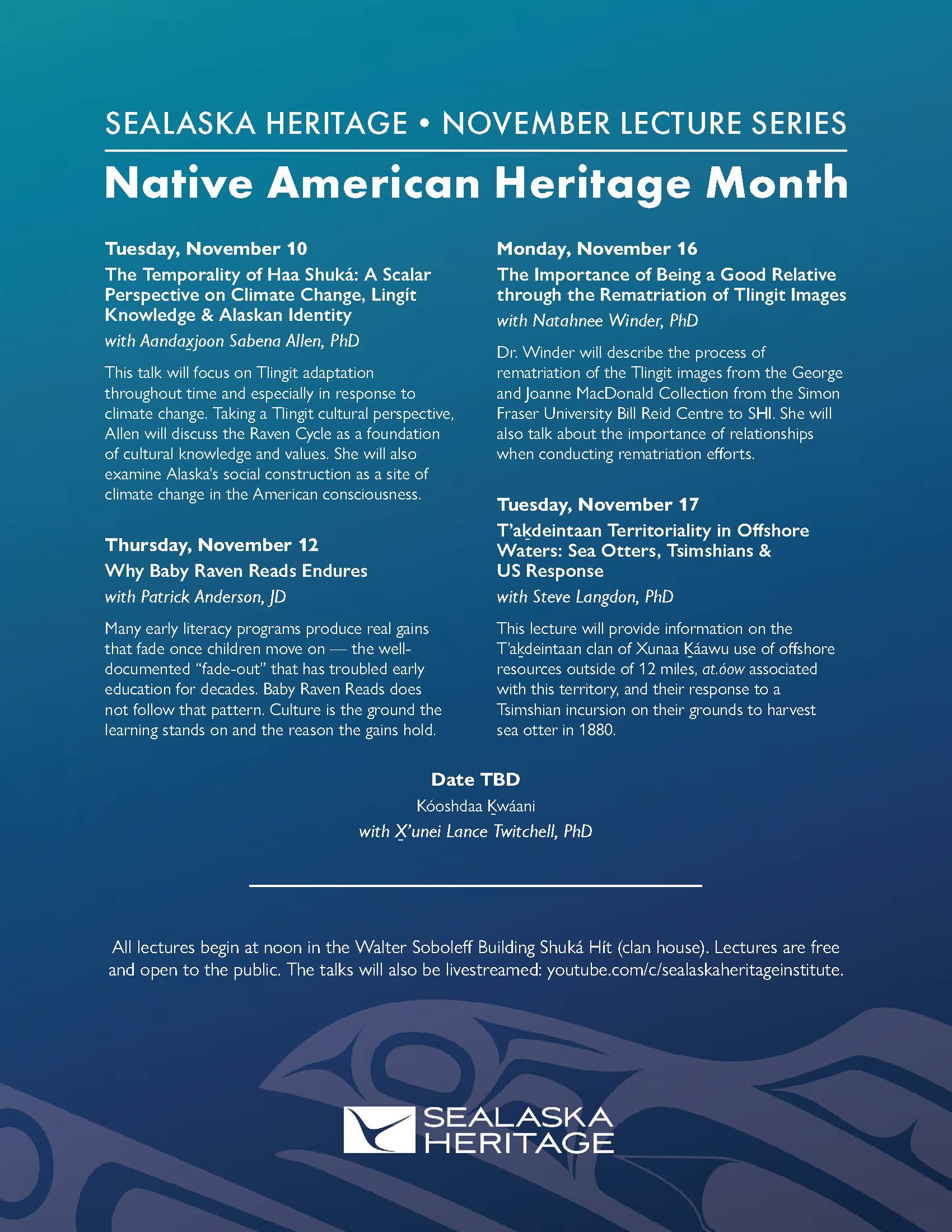
Each lecture will be held from noon-1 pm. The series is scheduled as follows:
Tuesday, Nov. 10
Lecture: “The Temporality of Haa Shuká: A Scalar Perspective on Climate Change, Lingít Knowledge, and Alaskan Identity” by Aandax̱joon Sabena Allen
This lecture will focus on Tlingit resiliency by examining Alaska’s social construction as a site of climate change in the American consciousness. Aandax̱joon, an assistant professor of Indigenous studies at the University of Alaska Fairbanks, will also examine three case studies on identity in Alaska in regard to place, Tlingit futurity and cultural authority in a changing environment.
Aandax̱joon is Gaanax̱teidí, a child of the Kaagwaantaan clan and an enrolled tribal citizen of Sitka Tribe of Alaska and Central Council Tlingit and Haida Indian Tribes of Alaska. She received her PhD in anthropology from the University of Chicago, and her work focuses on Tlingit oral history and climate change. Aandax̱joon uses Indigenous methodologies and community-based research to understand how traditional knowledge is being considered in responses to the changing environment, especially in non-profit and tribal government spaces.
Thursday, Nov. 12
Lecture: “Why Baby Raven Reads Endures” by Daaḵw ḵuwdéin Patrick M. Anderson
Anderson will speak about why children’s reading skills often deteriorate after leaving most early literacy programs and why that pattern doesn’t apply to SHI’s Baby Raven Reads program.
As a scholar, former educator and Tlingit Elder of the Shangukeidí clan from Xéitl Hít, Dry Bay, Anderson doesn’t believe more robust curricula will solve the well-documented “fade-out” effect plaguing early childhood education. In his lecture, he’ll explain why the methods behind Baby Raven Reads foster a successful learning environment for young children. According to Anderson’s research, Baby Raven Reads restores the conditions a child’s developing brain is designed to learn in. A trusted adult who reads and responds to the child fosters a sense of belonging while encouraging continuity of Alaska Native languages and traditional stories.
“Regulation and relationship come first; durable literacy is what consolidates on top of them,” he says. “Culture, in this account, is not enrichment added at the edges — it is the ground the learning stands on and the reason the gains hold.”
Monday, Nov. 16
Lecture: “The Importance of Being a Good Relative through the Rematriation of Tlingit Images” by Dr. Natahnee Winder
Dr. Winder is an assistant professor of Indigenous studies at Simon Fraser University (SFU). In her lecture, she will speak about the importance of relationships throughout the process of rematriating images of Northwest Coast First Peoples from the George and Joanne MacDonald Image Archive at SFU to SHI’s archives and collections department.
Dr. Winder was the 2015-2016 Henry Roe Cloud Fellow at Yale University, and she went on to complete her PhD in sociology at the University of Western Ontario. Her dissertation uses photovoice — a participatory research method in which community members use photography and personal narratives to document their lived experiences — to compare the residential school histories of Canada and the United States. Her research interests include Indigenous education and research, ethnic and race relations, community based participatory research and qualitative research.
Tuesday, Nov. 17
Lecture: “T’akdeintaan Territoriality in Offshore Waters: Sea Otters, Tsimshians and U.S. Response” by Dr. Steve Langdon
Dr. Langdon, professor emeritus of anthropology from the University of Alaska Anchorage, will lecture on the T’akdentaan clan’s use of offshore resources and response to an invasion in 1880, when Tsimshian arrived in Hoonah to harvest sea otter. Hoonah leaders told the Tsimshian they would kill them if they returned and met with a U.S. Naval Commander to explain the situation. The commander told the U.S. government he would tell the Tlingit to fight the Tsimshian if they returned.
Dr. Langon will speak about the impact the commander’s remarks had on Tlingit claims to unextinguished offshore aboriginal resource rights.
Date TBD
Lecture: “Kóoshdaa Ḵwáani” by X̱’unei Lance Twitchell
X̱’unei Lance Twitchell is an Assistant Professor of Alaska Native Languages at the University of Alaska Southeast. The date and details of his lecture will be announced in the coming weeks.
Sealaska Heritage Institute is a non-profit tribal organization founded in 1980 to perpetuate and enhance Tlingit, Haida and Tsimshian cultures of Southeast Alaska. Its goal is to promote cross-cultural understanding by educating the general public about the Indigenous cultures of Alaska. SHI also conducts scientific and public policy research that promotes Alaska Native arts, cultures, history and education statewide. The institute is governed by a Board of Trustees and guided by a Council of Traditional Scholars, a Native Artist Committee, a Southeast Regional Language Committee and an Education Committee.
CONTACT: Kathy Dye, Deputy Director of Publications and Communications, kathy.dye@sealaskaheritage.com
Caption: Flyer for SHI’s Native American Heritage Month lecture series. Note: News outlets are welcome to use this photo for coverage of this story. For a higher-res version, contact chloe.anderson@sealaskaheritage.com.