SHI publishes book examining landmark lawsuit on the definition of Indian tribes
Case clarified Alaska Native corporations and organizations are eligible for broader federal benefits under federal law
July 16, 2026
Sealaska Heritage Institute (SHI) has published a book on a landmark lawsuit that challenged whether Alaska Native corporations founded under the 1971 Alaska Native Claims Settlement Act (ANCSA) were eligible for federal emergency funds allocated to Indian tribes during the covid pandemic.
The case went all the way to the US Supreme Court, which found Alaska Native corporations are defined as Indian tribes under the Self-Determination and Education Assistance Act (ISDA) and therefore were eligible to receive funds under the Coronavirus Aid, Relief, and Economic Security Act, or CARES Act, and other federal Indian law benefits set aside for tribes.
Moreover, the court found organizations that have been created by ANCSA corporations — including nonprofits such as SHI, which was founded by Sealaska Corporation — also qualify for federal Indian programs under ISDA.
“The Sealaska Heritage Institute was established by Sealaska Corporation and is thereby a tribal organization under ISDA,” wrote the book’s author, Chris Shaakakóoni McNeil, owner of Native Strategy Group, former president and CEO of Sealaska Corporation and a Tlingit and member of the Nisga’a Nation.
Alaska Native corporations ultimately received approximately $450 million from the $8 billion set aside for tribal governments under the CARES Act. However, the corporations did not receive direct funding from the $20 billion tribal government pot in the American Rescue Plan Act (ARPA) of 2021. Despite the prior ruling by the Supreme Court in favor of the corporations, Congress and the administration of President Joe Biden explicitly limited ARPA to prevent a repeat of that allocation.
The full implications of the Supreme Court’s decision on Alaska Native corporations and their subsidiaries and nonprofits are not yet known.
Background
The book takes a deep dive into policy implications resulting from the historic Yellen v. Confederated Tribes of the Chehalis Reservation lawsuit. The book reviews the definition of “Indian Tribes” in Alaska under federal law, which was litigated during the Chehalis case.
The Chehalis case arose after Congress enacted the CARES Act on March 27, 2020. It provided $8 billion in direct payments to “Indian tribes,” igniting a heated debate over the term’s legal definition. The Chehalis Tribes spearheaded a lawsuit disputing claims that ANCSA corporations were eligible for these payments, arguing the corporations didn’t match the Indian Self-Determination and Education Assistance Act (ISDA) definition of “Indian tribes.”
Although the Supreme Court ultimately ruled that ANCSA corporations are Indian tribes, the Chehalis Tribes successfully lobbied to exclude corporations from receiving funding from the American Rescue Act of 2021, which included $31 billion dollars to benefit “Indian Country in general” and another $20 billion to be directly distributed to various tribes.
“Among other arguments, the Chehalis Tribes argued that the inclusion of ANCSA corporations would constitute double-dipping by including both Alaska Native federally recognized tribes and ANCSA corporations,” McNeil writes. “The opposite result occurred. Because of the allocation formula used by the Secretary of the Treasury, it worked to the extreme detriment of Alaska Natives generally.”
While there hasn’t been a formal accounting of the impact of the court’s decision, McNeil writes that excluding ANCSA corporations from receiving ARPA benefits caused Alaska Natives to lose several hundred million dollars. He goes on to state that excluding ANCSA corporations from Indian tribal funding formulas will continue to harm Alaska Natives, but there are several tribes working to reverse the Supreme Court’s decision, which still excludes ANCSA corporations from funding formulas in the majority of Indian tribal programs.
“In some greater sense it’s up to this generation of Alaksa Native leadership to seek innovative solutions. In my view it’s a question of imagination, the development of a strategic plan, allocation of necessary resources, and having the same fortitude that prior generations of Alaska Native leaders dedicated to protect our lands,” McNeil concludes.
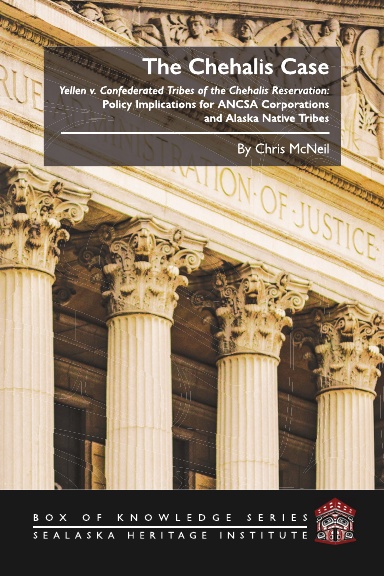
“The Chehalis Case: Yellen v. Confederated Tribes of the Chehalis Reservation: Policy Implications for ANCSA Corporations and Alaska Native Tribes” was published through SHI’s Box of Knowledge series and is available for purchase online or at the Sealaska Heritage Institute store.
Sealaska Heritage’s Box of Knowledge series consists of essays, reports and books that the institute considers should be made available as a contribution to studies on Tlingit, Haida and Tsimshian cultures, history and languages. They may be based on work carried out by researchers working in collaboration with SHI, contributions prepared by external experts and work by staff.
Sealaska Heritage Institute is a tribal organization founded in 1980 to perpetuate and enhance Tlingit, Haida and Tsimshian cultures of Southeast Alaska. SHI also conducts scientific and public policy research that promotes Alaska Native arts, cultures, history and education statewide. The institute is governed by a Board of Trustees and guided by a Council of Traditional Scholars, a Native Artist Committee, a Southeast Regional Language Committee and an Education Committee.
Caption: “The Chehalis Case: Yellen v. Confederated Tribes of the Chehalis Reservation: Policy Implications for ANCSA Corporations and Alaska Native Tribes” is pictured. Note: News outlets are welcome to use this photo for coverage of this story. For a higher-res version, contact kathy.dye@sealaskaheritage.com.