
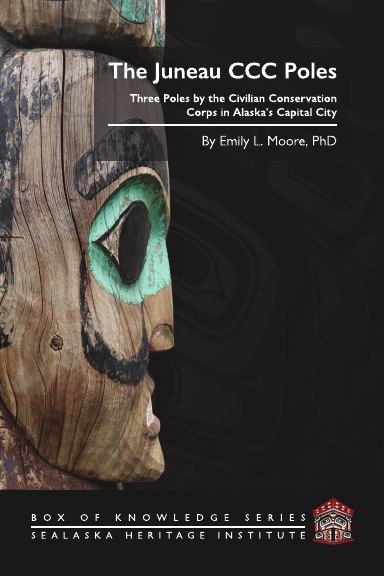
New book tells the story of three Juneau totem poles
“The Juneau CCC Poles: Three Poles by the Civilian Conservation Corps in Alaska’s Capital City” unravels a complicated history
July 3, 2026
Sealaska Heritage Institute (SHI) has published a book about three totem poles the Forest Service employed Tlingit and Haida men to create between 1938 and 1942.
“The Juneau CCC Poles: Three Poles by the Civilian Conservation Corps in Alaska’s Capital City” dives into the complicated relationship between the Forest Service and the Native carvers it employed.
The book’s author, Emily Moore, PhD, notes that the CCC totem pole project coincided with the Tlingit and Haida Indians of Alaska v. the United States lawsuit, which sought to reclaim millions of acres of Native land the Forest Service had set aside as the Tongass National Forest.
“The interwar period was a time of intense national interest in Native American art as ‘the most American’ of the nation’s art traditions, with Native art answering the call for a unique national art form that could not be traced to Europe,” Moore writes.
The disconnect between Native artists and the government entity employing them was reflected in the poles themselves. The “Governor’s Mansion Pole” holds no relevance to local Tlingit people and was erected to serve as a tourist attraction. The “Yax̱té Pole” at Auke Bay and the “Sa’wan and the First Halibut Hook” pole downtown both hold cultural significance, but their meanings were misinterpreted for many years.
Kaigani Haida carver John Wallace created “Sa’wan and the First Halibut Hook” to tell the story of a Tlingit shaman. The pole was meant to stand near the Taant’a Ḵwáan Tlingit community of Ketchikan, but the Juneau Chamber of Commerce purchased it in the summer of 1962 – just weeks after the city’s fire department burned the Douglas Indian Village down to build a harbor.
“While there is no known correlation between these events and the Chamber of Commerce’s purchase of John Wallace’s pole for Juneau in July 1962, it is important to acknowledge the larger pattern here: non-Native support for Native art but not for Native land,” Moore writes.
However, Moore writes, the CCC totem pole program wasn’t just a bureaucratic ploy by the government, nor were the poles completely devoid of meaning to Native communities. The poles were – and still are – attractions with cultural significance, and the effort CCC carvers put into honoring cultural protocols while negotiating these government commissions is apparent.
“The ‘emergent authenticity’ of the “Yax̱té Pole” – and of many CCC poles that are now cared for by Native communities – speaks to the complicated legacy of the CCC program,” Moore writes.
“The Juneau CCC Poles: Three Poles by the Civilian Conservation Corps in Alaska’s Capital City” was published through SHI’s Box of Knowledge series, which consists of books and essays about Tlingit, Haida and Tsimshian culture. The series is available through the Sealaska Heritage Store.
Sealaska Heritage Institute is a tribal organization founded in 1980 to perpetuate and enhance Tlingit, Haida and Tsimshian cultures of Southeast Alaska. SHI also conducts scientific and public policy research that promotes Alaska Native arts, cultures, history and education statewide. The institute is governed by a Board of Trustees and guided by a Council of Traditional Scholars, a Native Artist Committee, a Southeast Regional Language Committee and an Education Committee.
Caption: Cover of SHI’s new book “The Juneau CCC Poles: Three Poles by the Civilian Conservation Corps in Alaska’s Capital City.” Note: News outlets are welcome to use this photo for coverage of this story. For a higher-res version, contact kathy.dye@sealaskaheritage.com.